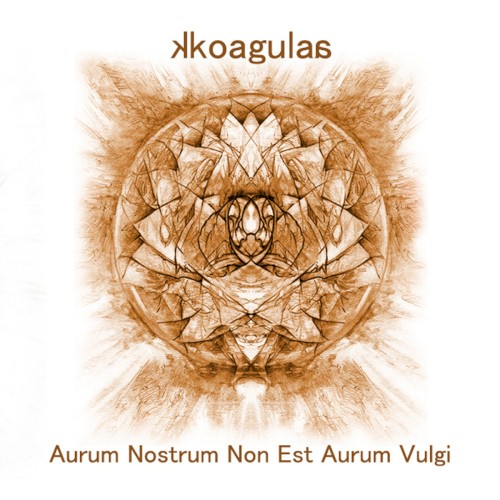
Aurum Nostrum Non Est Aurum Vulgi
kkoagulaa
- Style
- Avant-Garde/Electronica
- Label
- Aural Music/Code666
- Year
- 2010
- Reviewed by
- Charles
So much for the talk. It would clearly be completely meaningless if Aurum Nostrum Non Est Aurum Vulgi couldn’t deliver into assembled ears something truly without limits. The 55 minutes here are not divided into tracks; this is one long procession of ideas, merging into eachother like the work of a dj. In fact, you can imagine this as the accompaniment to some kind of light and dance show; different moods and different tonal colourings flowing together sounding more like they are supposed to be a sonic backdrop for a pre-eminently visual experience. Or maybe not even visual- in its approach, if not its sound, it reminds me a little of Mike Patton’s Pranzo Oltranzista, which is supposed to be music to eat surrealist food to whilst blindfolded. This might ring alarm bells. Surely the flip-side of this “multimedia” approach is the sneaking suspicion that it can’t really stand up on its own as music. Does it really deserve centre stage? In a way, this is background music- but background music that is going to let you appear particularly hip as the host of future dinner parties.
Of course, it would be very misleading to say that this is without precedent or musical reference point. Obviously it would be silly to think that listening to more recent Manes releases wouldn’t give you at least some idea of what to expect from this. In fact, there are understandably a lot of similarities between the music here and How the World Came to an End, for example (I must confess to missing Manes’s last one). Similar experiments with ambient textures and hypnotic, shifting drum patterns abound. The difference here is that there aren’t any delineated “songs” with particular ideas or moods, and the role of the vocals is generally much smaller, often as simply another layer of instrumentation (although there are various traces of the same talky-narrative style at points). Instead of individual pieces, we have a continuous weave of different textures, some of which lull you with their hypnotic trip-hop feel, and others (such as the opening) simultaneously disorientate and invigorate you with their dissonant collage of sound- carefully constrained chaos. This is very much the work of those bands with roots in the gritty early days of black metal who have since moved into experimental electronic terrain. Ulver are the almost certainly the most celebrated example, although compared to, say, Blood Inside this is less about abstract sonic strangeness and more about a pulsating percussive tapestry that is far less dark and oppressive.
And it is in this weave of textures that this album really achieves something worthwhile. As one curious synth line or off-kilter breakbeat blurs and smears slowly into another, it becomes apparent that the beauty of this lies solely in the sonic impressions it creates. Forget melody or riffs- at its best this is simply about the invention of interesting sounds, and nothing more. At its worst, it feels a little ephemeral, but I suspect that might be an inevitable side-effect of what they are attempting.
I have a lot of sympathy for this album- any band that can straight-facedly inform me that “your grandma and your cat are both integral to kkoagulaa” (buy it and find out what I’m talking about) gets instant sympathy. It is a worthwhile approach to music that seeks to do something really distinctive. Not really close to the revolution it bills itself as, but it’s probably a progression nonetheless, into musical realms where boundary walls are little bit lower, and the flow of sound a little bit freer.
Reviewed by Charles — February 22, 2010