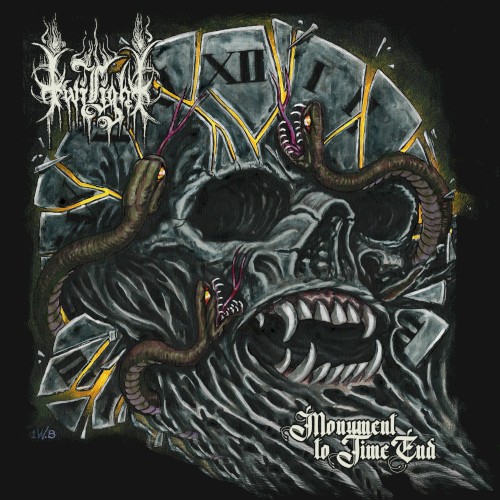
Monument to Time End
Twilight
- Style
- Progressive Black Metal
- Label
- Southern Lord
- Year
- 2010
- Reviewed by
- Charles
Moreover, according to Southern Lord, the writing process has been a more collaborative one than the Wrest-dominated affair of the self-titled, and so you’d expect the impact of those changes to be amplified further. The upshot is that this is a really interesting record. Throughout, it is slicked over on the surface by the putrid black oil that makes bands like Leviathan such an ugly prospect. But whilst this USBM orthodoxy is kept centre-stage by the hoarse, crackling vocals (mainly split between Imperial and Turner, although Robert Lowe of Om guests with some clean contributions) and scuzzy sound, it has to wrestle with attackers from all sides. So this is penetrated at multiple points by new ideas, from Instinct: Decay or Assassins-inspired proggy noodling (particularly on 8,000 Years) to slow, sludgy build-ups or thudding quasi-industrial brooders. As such it really lacks the low-fi ugliness of the last one (all but the most elitist or perverse will probably say more for better than worse), and instead becomes an epic, exploratory work full of rich textures and enigmatic moods.
So let’s run through some of the points of interest here. Opener The Cryptic Ascension crashes over you with its reverberatingly melancholic Isis churn, leaving you in no doubt that this is a wholly different record to its predecessor. Get over your disappointment (if you had any) that this is not as uncompromisingly horrible-sounding as you may have hoped, and the curious fusion of post-sludge murmuring and grimy blackened ambiance is something quite appealing. As with a great deal of Monument…, this is a long tune with various phases. Here, there is a brief interlude of bespectacled Amesouers-invoking indie before we switch up a gear into an all-encompassing black metal whirlwind, the likes of which is generally rarer but nonetheless an ever-ominous threat. In fact, if you take something like Convulsions in the Wells of Fever, you’re left with the impression that this side to their sound is stronger than ever, if used more sparingly. It’s a stormer of a track, with the whole band hacking through up-tempo tremolo riffs, with rhythmic contortions and multi-layered textures giving it both depth and edge.
Then there are the curiosities, although it is to the album’s credit that the more unusual tunes herein never jar the overall flow. Take Red Fields; a slow and imposing tune with a heavy industrial feel, sounding a little like it belongs on code666’s recent Better Undead Than Alive 2 compilation alongside Axis of Perdition or Minethorn. Same goes for Negative Signal Omega, which closes this on a very weird note, sounding like a blackened version of a synth soundtrack from an Italian exploitation film. Lowe’s contribution here is striking, as the track culminates in a despondent, almost Radiohead (circa OK Computer)-like moaning dirge.
It is probably an improvement, then, on Twilight, avoiding the inclusion of weaker tracks and the tedium that can arise when “depressive” black metal elements are dwelt on for too long. It is far less twisted and abrasive, which may or may not be a loss depending on your perspective (personally I miss the unmitigated swamp-thing hideousness of tracks like Hopeless Etheride), but it compensates by being so adventurous and full of hidden depths. Certainly one of the best black metal albums of this year so far, from a supergroup that is really starting to deserve the name.
Reviewed by Charles — March 20, 2010