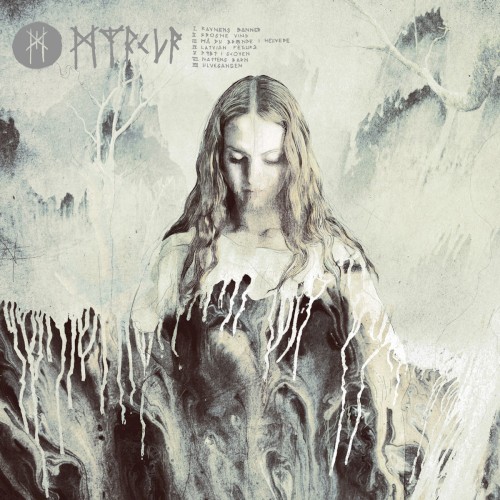
A lot of other people that have written about this have made much of the early Ulver influence- specifically the lovely forest folk of Bergtatt, rather than the more earsplitting Nattens Madrigal. That is by no means the whole story, but there is an indisputable stylistic connection. Think of those moments on Bergtatt where the clean vocal harmonies glide gracefully over the black metal rhythm section; it has a kind of magical quality and I think that is what Myrkur is trying (often very successfully) to channel at many points on this EP. But it’s more like a response than an imitation. Where Ulver’s music felt very nocturnal, the clean harmonies here have this strange, celestial quality to them (reflecting the definite non-blackness of the cover). The a capella sections which prelude many of the tracks are solemn and reverential but also extremely warm… Honestly, it reminds me of Christmas music (I mean In the Bleak Midwinter, rather than Shakin’ Stevens). But the effect of it is at times quite special. Ravnens Banner, Nattens Barn, or Latvian Fegurð... all these tracks feature very pronounced treble melodies winding over an extremely basic black metal rhythm section which could be plucked from the early 1990s. The dreamlike charm of the former amply justifies the latter, but are elevated into something quite unique when those vocals float in over the top.
So it’s true that at times Myrkur chanels and reshapes the feel of Ulver’s music, but of course a lot has gone on in black metal since then, and it also bears very obvious hallmarks of more recent ‘post’ influences. Dybt I Skoven is the case in point here: there is a very obvious influence from the likes of Alcest. Overall, there are a couple of weaknesses. The first is disjointed songwriting. I suppose it is part of the intentionally primitive approach, but I felt there were too many abrupt jolts between ideas. A new riff will be introduced by simply stopping the old one and starting again. The second is that it is perhaps over-reliant on the quirks described above to give it an identity. This point feels a bit ungrateful: after all, simply by having a distinct identity in the first place it is already way ahead of the vast majority of black metal projects. But, I am not sure how well the techniques on display here would last over a full-length album. Still, as an EP, this is at the very least an interesting curiosity and I would say more than that.
Reviewed by Charles — August 22, 2014